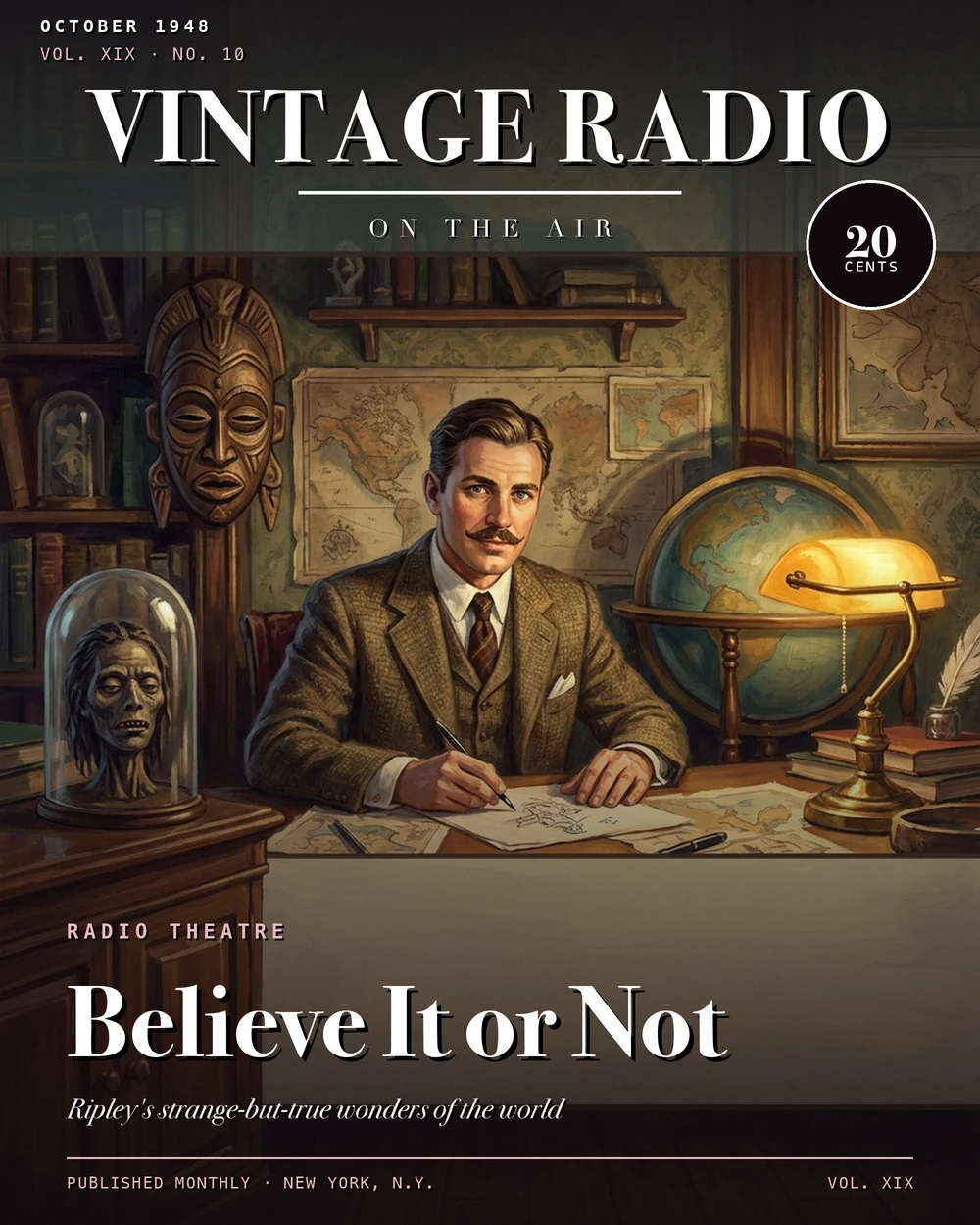
Believe It or Not
The Man Behind the Microphone
Robert L. Ripley should not have worked on radio at all. His biographer Bob Considine described his early broadcasts as "mumbling, fumbling, stumbling… compounded of simple mike fright and gross ineptitude." During those first appearances, the script shook in Ripley's hands, fell to the floor, and he nearly knocked the microphone into the audience. He was burdened by shyness and a stutter that made live performance a genuine ordeal. Considine, who had access to early transcriptions for his biography, concluded: "Never did so miscast a performer score so sweeping a success."
And yet it worked. Ripley's radio debut came in 1930 on the Blue Network's Collier Hour, where he opened with his famous "Marching Chinese" assertion — that if all the Chinese marched four abreast past a given point, they would never finish passing. He worked through the math on air: using U.S. Army marching regulations, 26,280,000 Chinese would pass a given point each year, but with a 10 percent birth rate and half dying in infancy, 30 million new marchers would be added annually. The audience response was strong enough that NBC gave him a regular Monday night slot beginning April 14, 1930. That was the start of a broadcasting run that stretched, in one form or another, all the way to September 3, 1948.
The reason a stuttering cartoonist could be handed a network slot after a single guest spot was simple: Ripley was already one of the most famous men in America. He had been a newspaper cartoonist since around 1909, when the San Francisco Bulletin hired him; in 1918 he began drawing a panel of sports oddities, and by 1929 Simon & Schuster had collected his most startling cartoons into a book. That same year, his November 3 cartoon panel asserting that America had no national anthem set off a national outcry — eventually leading President Herbert Hoover to sign the bill designating "The Star-Spangled Banner" as the national anthem in March 1931. By 1929, Hearst's King Features Syndicate was running Believe It or Not in 360 newspapers and 17 languages; at its peak the feature reached roughly 80 million daily readers, and during the first three weeks of May 1932 alone, Ripley received over two million pieces of fan mail. Nine people at King Features were kept busy answering it. The New York Times voted him the most popular man in America by the mid-1930s, Dartmouth gave him an honorary degree, and in a 1936 Boys Club of New York poll asking children whom they most wanted to be, Ripley beat President Franklin Roosevelt, Jack Dempsey, and Henry Ford. His real first name was LeRoy — he added Robert around age 20, when management at the New York Globe decided "Leroy" was not athletic enough for a sports cartoonist. He claimed Christmas as his birthday, though Considine said he was actually born December 26, 1893. He was, as the press described him, his own kind of curiosity.
How the Show Found Its Shape
The early NBC and Blue Network runs were relatively modest. The first regular NBC run, sponsored by Colonial Beacon Oil Company, aired Monday nights from April 1930 to January 1931. A Blue Network run followed from May 1931 to June 1932 on Wednesdays and Fridays, sponsored by Standard Oil under the Esso brand. For the Esso show, Ripley told travel stories and related items from his Believe It or Not files. These were building blocks, but the format that made the show memorable didn't fully click into place until 1933.
That year Ripley was added to B. A. Rolfe's Saturday night variety program, and producer Douglas F. Storer became what he would remain for years — Ripley's guiding force on radio. Storer's key innovation was dramatization. Instead of Ripley reading oddities aloud, the show would stage each story as a brief dramatic play, with professional actors often working in ethnic dialects to suit the country where each tale took place. Ripley would introduce the piece in less than a minute and then return afterward to authenticate what the audience had just heard. The 1934 NBC run reflected this new shape: a 60-minute Saturday broadcast joining the Saturday Party series, with Curt Patterson announcing, vocalist Linda Lee, and Rolfe directing the orchestra. It was packaged with dance music, novelty tunes, and commercials for the Hudson Terraplane. Ripley was introduced on air as "Radio's regal revealer of remarkable realities" — a tongue-twister he carried into later shows. He took diction lessons to get his stutter under control, and for his microphone fright, he reportedly relied on a few drinks before broadcasts — sometimes, according to those around him, more than a few.
What almost no listener knew was where the oddities themselves came from. In 1923, Ripley had hired a Polish-born polyglot named Norbert Pearlroth — a former bank teller who spoke 14 languages — as his full-time researcher. Pearlroth would spend the next 52 years working ten hours a day, six and sometimes seven days a week, in the Main Reading Room of the New York Public Library, examining roughly 7,000 books a year and answering some 3,000 letters a week from readers disputing Ripley's facts. By his own count, he was wrong only once: a man named Seaborn whom he had described as born at sea was actually born aboard a ship at anchor in a harbor. Pearlroth supplied virtually every oddity that Ripley introduced on the air, and Ripley kept his existence quiet — Pearlroth appears only as "Research Director" in the 50th Anniversary Edition of Believe It or Not, received no pension and no royalties, and was finally replaced by King Features in 1975, though he continued supplying material even after his forced retirement. By 1935 Ripley's staff was also receiving hundreds of tips a day about unusual happenings from listeners around the country, but the engine in the library was always Pearlroth.
Going to the Source
What set Believe It or Not apart from other oddities programs was Ripley's insistence on going where the stories were. He was one of the first radio performers to make regular use of remote pickups, and he used them for genuinely strange purposes. He spoke via remote with rapids-runners on the Colorado River and with people trekking under Niagara Falls. He interviewed a polio victim in an iron lung. He talked by shortwave with Douglas "Wrong Way" Corrigan — who had flown from the United States intending to reach California and landed instead in Dublin, Ireland. He also recorded live broadcasts from inside the Carlsbad Caverns, and reportedly broadcast one show while skydiving.
In 1938, Ripley staged a firewalking event in the parking lot at Radio City, describing on air how Kuda Bux of India traversed a bed of hot coals. He claimed to be the first person to broadcast from mid-ocean, and claimed his voice had been heard from more distant places than any other speaker's. He broadcast live from Schenectady to Sydney, then traveled 10,000 miles to keep a blind date with a woman he had interviewed on air. Storer believed listeners were fascinated by radio's new ability to reach distant locales, and Ripley embodied that fascination completely.
The 1939–1940 CBS run, subtitled See America First with Bob Ripley, traveled on location with a full crew — vocalist, agency representative, writers, and engineers. They visited the floor of the Grand Canyon and an underwater garden off the coast of Florida. During the Grand Canyon broadcast, Ripley's Colorado River guide Emery Kolb could not steer the boat and operate the shortwave radio at the same time, so the crew enlisted an amateur radio operator on hand — a young man named Barry Goldwater, who decades later would become a U.S. Senator and the 1964 Republican presidential nominee. The 1942 Blue Network run went further still, framing itself as a tribute to Latin America and featuring rhumba and samba music under the musical direction of Al D'Artega and B. A. Rolfe.
The Strangest Moments
The show produced moments that simply could not have happened anywhere but live radio. On one broadcast, Ripley and a snake handler were lowered into a pit of rattlesnakes. When a power failure plunged the pit into darkness, listeners heard the snake handler announce: "Let's get the hell out of here!" That kind of uncontrolled reality was exactly what made Ripley's remote-pickup philosophy compelling.
Newsweek described Ripley as "habitually blushing." Radio Guide in 1940 called his show "consistently the most interesting and thrilling program on the air." Those two descriptions together capture something true about the program: it was the work of a genuinely uncomfortable man who had found a format that turned discomfort into theater. Ripley guaranteed the truth of his stories — but was not above adjusting his "authentication" segments for dramatic impact.
During World War II, the 1944 Mutual daily series ran five days a week and focused on "amazing new wonders culled from a world at war," with Ripley tying events from antiquity to current wartime headlines. One episode recounted a British patrol trapped in the same valley where Israelites were surrounded by Philistines 3,000 years earlier — and escaping through the same passage. Another told of a young American nearly hit by enemy shrapnel that bore his father's name, cut into the engine of a 1929 automobile while the father worked as a mechanic at Boeing Aircraft. Ripley collected cars himself, though he did not drive. He had, according to those around him, an almost superstitious fear of the telephone.
Eighteen Years Across Every Network
The full run of Believe It or Not touched nearly every major American broadcast network across close to two decades. NBC, the Blue Network, CBS, and Mutual all carried versions of it at various points. Sponsors included Colonial Beacon Oil, Standard Oil's Esso brand, Hudson Motor Car Company, Fleischmann's Yeast, General Foods, Royal Crown Cola for Nehi, Pall Mall Cigarettes, and the cosmetics company Bourjois. The 1935–1937 Blue Network run, titled The Baker's Broadcast and sponsored by Fleischmann's Yeast, featured vocalists Ozzie and Harriet Nelson — who married on October 8, 1935, in the middle of the run — and was directed by Ed Gardner before his Duffy's Tavern fame. The program drew a 16.0 Hooper rating in its first season, placing it eleventh in the Top 50 and third on Sunday nights behind Major Bowes and Jack Benny. In his 2013 biography A Curious Man, Neal Thompson called the Ripley version of the Baker's Broadcast "one of America's favorite shows, in league with the top-ranked shows of Jack Benny and Bing Crosby." Ben Grauer and Graham McNamee announced the 1937–1938 run. The 1945 CBS series ran under the title Romance, Rhythm, and Ripley.
The final NBC run, which aired from May 12, 1947, to September 3, 1948, went out five days a week under the title Pages from Robert L. Ripley's Radio Scrapbook. Gregory Abbott, described on air as "the dean of newsreel commentators," served as narrator. The creator-producer was Douglas Storer — the same man who had reshaped the show in 1933 and stayed with it through its many transformations. Ripley himself died on May 27, 1949, less than a year after the final broadcast.
When American troops stormed the beaches of North Africa during World War II, one of the passwords used to identify friend from foe was "believe it or not." That a catchphrase from a radio oddities show had worked its way into a military operation says something about how deeply the program had embedded itself in American life. Ripley had been, as Considine put it, miscast from the start — and he ran with it for nearly two decades.